

 Academy
Wooden wick sample pack for candle making
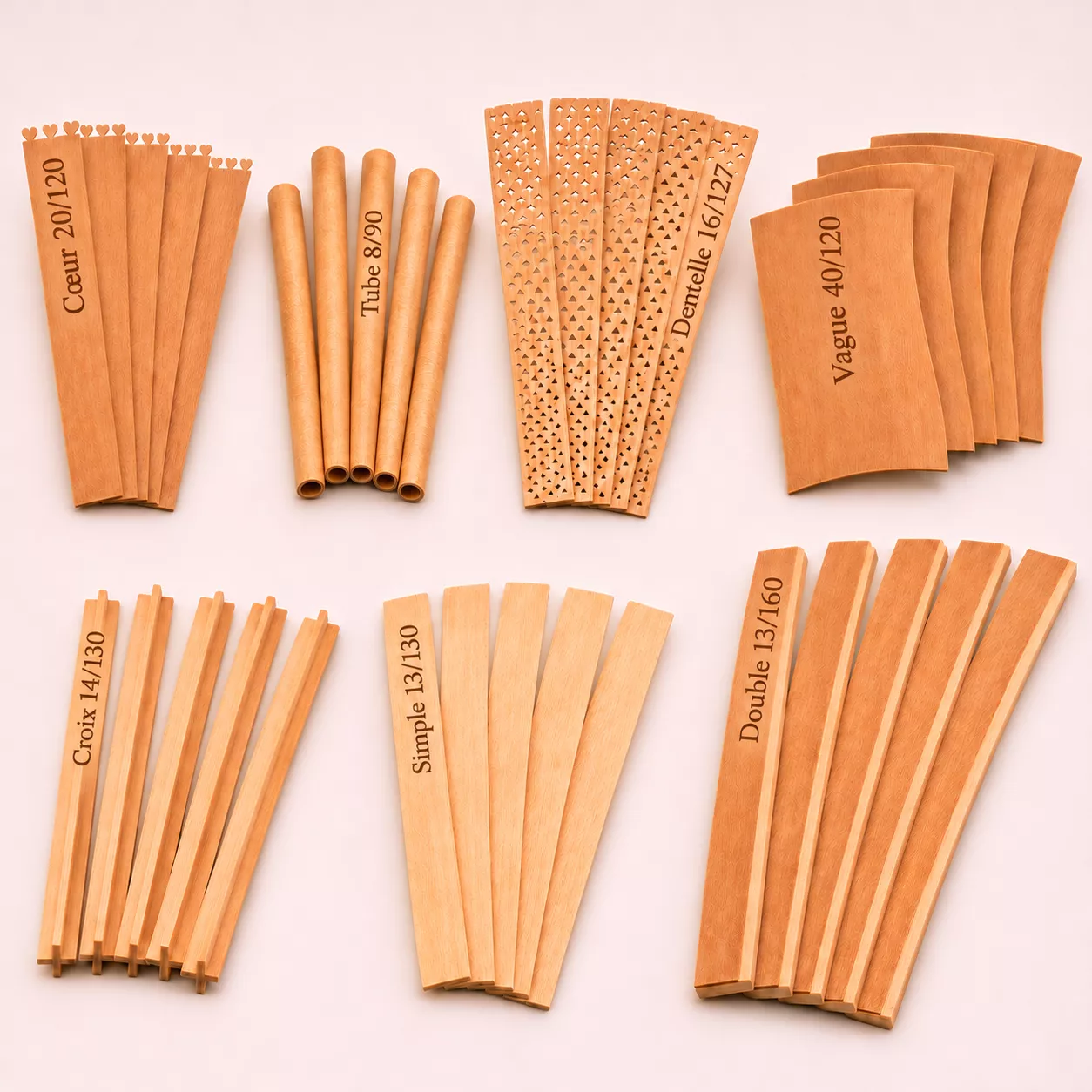
Test 7 wooden wick designs, with 5 wicks per design, in your wax and container. Compare the wick shapes, flame stability and how the wax melts around them.
Pack highlights
- 7 wooden wick designs
- 5 wicks per design
- 35 wicks in total
No minimum order
For orders containing discovery packs only.
Price per pack
Price:
€30.00
VAT excluded Any delivery charges are calculated at checkout
In stock
Pack contents
35 wooden wicks. The references included are listed below.
This pack is for container candle makers choosing between several wooden wick shapes. Five wicks per design let you repeat a test or confirm the result with a variation of your formula.
| Samples included | Quantity |
|---|---|
| Heart · 20/120 | 5 |
| Tube · 8/90 | 5 |
| Lace · 16/127 | 5 |
| Wave · 40/120 | 5 |
| Cross · 14/130 | 5 |
| Single · 13/130 | 5 |
| Double · 13/160 | 5 |
Plan your tests
Which wooden wick shape should you choose?
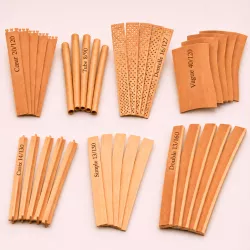
Tube has a cylindrical profile, Lace an openwork shape, while Single and Double give a straighter line. Place a few designs in your empty jar to compare their size and appearance. Shortlist two or three shapes suited to the diameter and style of the candle.
A shape that looks right still needs a burn test. To compare the designs, observe ease of lighting, flame stability and melt pool development. Results also depend on the internal diameter, wax and fragranced or coloured formula.
What should you record during a burn test?
Identify the wick design and dimensions, wax reference, container and formula. Compare candles at equivalent stages, from the first burn through successive burns. Record differences in flame stability, wax melting and wick performance.
The dimensions in the table distinguish the designs. To choose a wick for a new container, use the ADC guide and repeat the test in the finished candle. A good result in one glass does not automatically carry over to a different diameter.
How to organise your tests
1. Measure the internal diameter of the container at the fill level. Select the designs you want to compare.
2. Make one candle per design using the same container, wax and formula. Label each prototype.
3. Compare burning and appearance over equivalent burns. Set aside designs with an irregular flame or unsuitable wax melting.
4. Use a second wick of your chosen design to check that the result can be reproduced with the final formula.
Frequently asked questions
How many wicks of each shape do I receive?
The pack contains five wicks of each design, for a total of 35 wicks.
Do I need to test all seven designs?
Start with shapes suited to your container and the appearance you want. Use the rest of the pack to widen your tests if needed.
Can I keep the same wick when changing jars?
Run another test in the new jar. Its internal width can change flame behaviour and wax melting.
Explore more at ADC
Pack contents
35 wooden wicks. The references included are listed below.
This pack is for container candle makers choosing between several wooden wick shapes. Five wicks per design let you repeat a test or confirm the result with a variation of your formula.
| Samples included | Quantity |
|---|---|
| Heart · 20/120 | 5 |
| Tube · 8/90 | 5 |
| Lace · 16/127 | 5 |
| Wave · 40/120 | 5 |
| Cross · 14/130 | 5 |
| Single · 13/130 | 5 |
| Double · 13/160 | 5 |
Which wooden wick shape should you choose?
Tube has a cylindrical profile, Lace an openwork shape, while Single and Double give a straighter line. Place a few designs in your empty jar to compare their size and appearance. Shortlist two or three shapes suited to the diameter and style of the candle.
A shape that looks right still needs a burn test. To compare the designs, observe ease of lighting, flame stability and melt pool development. Results also depend on the internal diameter, wax and fragranced or coloured formula.
What should you record during a burn test?
Identify the wick design and dimensions, wax reference, container and formula. Compare candles at equivalent stages, from the first burn through successive burns. Record differences in flame stability, wax melting and wick performance.
The dimensions in the table distinguish the designs. To choose a wick for a new container, use the ADC guide and repeat the test in the finished candle. A good result in one glass does not automatically carry over to a different diameter.
How to organise your tests
1. Measure the internal diameter of the container at the fill level. Select the designs you want to compare.
2. Make one candle per design using the same container, wax and formula. Label each prototype.
3. Compare burning and appearance over equivalent burns. Set aside designs with an irregular flame or unsuitable wax melting.
4. Use a second wick of your chosen design to check that the result can be reproduced with the final formula.
Frequently asked questions
How many wicks of each shape do I receive?
The pack contains five wicks of each design, for a total of 35 wicks.
Do I need to test all seven designs?
Start with shapes suited to your container and the appearance you want. Use the rest of the pack to widen your tests if needed.
Can I keep the same wick when changing jars?
Run another test in the new jar. Its internal width can change flame behaviour and wax melting.
Explore more at ADC
Category Discovery Packs
Category Discovery Packs
Pack contents
35 wooden wicks. The references included are listed below.
This pack is for container candle makers choosing between several wooden wick shapes. Five wicks per design let you repeat a test or confirm the result with a variation of your formula.
| Samples included | Quantity |
|---|---|
| Heart · 20/120 | 5 |
| Tube · 8/90 | 5 |
| Lace · 16/127 | 5 |
| Wave · 40/120 | 5 |
| Cross · 14/130 | 5 |
| Single · 13/130 | 5 |
| Double · 13/160 | 5 |
Which wooden wick shape should you choose?
Tube has a cylindrical profile, Lace an openwork shape, while Single and Double give a straighter line. Place a few designs in your empty jar to compare their size and appearance. Shortlist two or three shapes suited to the diameter and style of the candle.
A shape that looks right still needs a burn test. To compare the designs, observe ease of lighting, flame stability and melt pool development. Results also depend on the internal diameter, wax and fragranced or coloured formula.
What should you record during a burn test?
Identify the wick design and dimensions, wax reference, container and formula. Compare candles at equivalent stages, from the first burn through successive burns. Record differences in flame stability, wax melting and wick performance.
The dimensions in the table distinguish the designs. To choose a wick for a new container, use the ADC guide and repeat the test in the finished candle. A good result in one glass does not automatically carry over to a different diameter.
How to organise your tests
1. Measure the internal diameter of the container at the fill level. Select the designs you want to compare.
2. Make one candle per design using the same container, wax and formula. Label each prototype.
3. Compare burning and appearance over equivalent burns. Set aside designs with an irregular flame or unsuitable wax melting.
4. Use a second wick of your chosen design to check that the result can be reproduced with the final formula.
Frequently asked questions
How many wicks of each shape do I receive?
The pack contains five wicks of each design, for a total of 35 wicks.
Do I need to test all seven designs?
Start with shapes suited to your container and the appearance you want. Use the rest of the pack to widen your tests if needed.
Can I keep the same wick when changing jars?
Run another test in the new jar. Its internal width can change flame behaviour and wax melting.
Explore more at ADC
DEDICATED
SUPPORT
VOLUME
PRICING
24H DELIVERY
IN EUROPE
900+ M² OF
STOCK SPACE
PAYMENT IN
INSTALMENTS
Ordering in large quantities?
Questions about delivery? Need more information about our products?
Talk to our team to request a tailored quote, order a sample or ask about our prices.

Request a quote
Related products
Experts working for professionals
Expertise. Responsiveness. Professionalism.
What makes ADC Solution different
Support tailored to your needs
- Écoute active et humaine
- Des conseils personnalisés
- Accompagnement technique pour mieux gérer les difficultés
- Produits adaptés aux exigences pro
- Des offres de services spécifique
à chaque client :
- Gestion des volumes
- Gestion de trésorerie
Customer reviews
- Note client moyenne : 4,8/5
- Christopher F-J : « Fournisseur à l’écoute, très réactif et toujours chaleureux »
- Hugo P : « Équipe à l’écoute, réactive et professionnelle »
- Jeanne L : « oujours disponible pour conseiller et accompagner un projet »
Distinctive products
- Fabricant de sa propre marque
- Des produits uniques et 100% végétaux
- Des produits 100 % écologiques en
circuits courts - Contrôle qualité rigoureux à chaque étape
de fabrication - + de 40 ans d’expérience dans la cire
- Tracabilité et transparence des produits